People who shape the future: a conference on human resource management and technological transformation was held in Kyiv
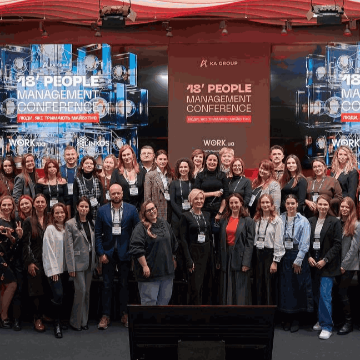
On December 19, Kyiv hosted the 18th PEOPLE MANAGEMENT CONFERENCE. CEOs, HRDs, business owners, analysts, and educational and social leaders attended. 1+1 Media served as the general media partner.
The conference provided a forum for in-depth dialogue on how people management is evolving amid war, labor shortages, and rapid technological change.
From HR function to people as the strategic core.
For 10 years in a row, the 18th PEOPLE MANAGEMENT CONFERENCE has consistently promoted an idea that has become a management standard: “All managers are people managers.”
KA Group founder Alona Zhupikova opened the event. She stressed that, amid team exhaustion, demographic losses, and turbulence, management maturity is demonstrated less by processes and more by the ability to work with living systems—trust, motivation, energy, meaning, and responsibility.
“We are not looking for simple answers. We think and act like architects. We consciously create space for honest management conversations and complex decisions. This keeps business, teams, and the future going today,” she emphasized.
Three blocks – three responses to reality.
The conference program was structured as an architecture of thinking that responds to the key challenges of our time.
Reality on the brink – what to do here and now. The first block focused on demographic shifts and labor market competition.
Ella Libanova, director of the Institute for Demography and Social Studies, outlined a forecast for depopulation even if some migrants return. She estimates about a third may come back. The deciding factors will be security, work, housing, and a clear “picture of the future.”
Prometheus co-founder Ivan Prymachenko emphasized that human capital today is not only about efficiency but also about the second chance that education and retraining provide, regardless of age or status.
Artur Mikhno, co-owner and CEO of Work.ua, showed that the labor market recovered after 2022. He stressed companies win by building HR brands around meaning, trust, and involvement—not just salaries.
Marina Starodubska, author of “How to Understand Ukrainians: A Cross-Cultural Perspective,” stressed an important management point: in wartime, Ukrainians need a different way to adapt to change. Managing people in Ukraine works best not by copying external models or by relying on formal rules, but through personal connection, clear communication, and shared decision-making. Trust is built within small groups and between individuals, so leading with kindness, open talk, and responsibility is key to real change.
Sociologist and founder of Gradus Research, Yevheniia Blyzniuk, presented data on mental health: 72% of citizens rate their quality of life as low, and fatigue, anxiety, and decreased motivation form a backdrop that directly affects productivity and decision-making.
Foresight and solutions—technology, people, and a new management logic.
The second block focused on the role of AI and human augmentation.
EY Ukraine Executive Partner Olga Gorbunovska, drawing on EY Work Reimagined 2025, noted that AI is inevitable. Still, only a few achieve the expected ROI, mainly due to human factors rather than technology.
The panel discussion showed that AI does not reduce the workload but increases cognitive complexity. Companies that invest in training, structured processes, and critical thinking, while viewing people as technology orchestrators, will win. The panel also emphasized HRD's role as a work designer and CEO partner in building systems that support people rather than exhaust them.
In a panel on conflicts, organizational experts noted that it is not conflict itself that harms teams, but a lack of trust, fear of open communication, and a reluctance to take responsibility. Strong teams turn tension into real agreements.
The ethical recruiting discussion delivered a key management lesson. In a human capital shortage, hiring is a strategic decision, not just an operational step. Recruitment mistakes scale quickly, leading to lost trust, reduced productivity, and instability within the team.
Ethical recruiting is not about tone or “softness.” It depends on the system's maturity—transparent processes, responsible tool choices, feedback, and a business's willingness to invest in people. This logic shapes long-term hiring that supports businesses during structural change.
Cultures of the future – dignity, inclusion, environment.
The third block opened up a long-term perspective.
IREX Project Director Yulia Tkachuk called veteran reintegration a key challenge for 2025–2030. Veterans are an asset, not a risk, and this should be part of workplace dignity culture.
Mental health consultant Yulia Bashlakova emphasized that reintegration is a social contract and a shared responsibility of business, society, and the state.
Architect Mark Savitsky's presentation struck the final note on the architecture of dignity—physical spaces as a tool for psychological stability and retention. Environments designed with universal design in mind benefit all teams.
The conference showed a key shift: competition for human capital is now systemic. Companies and countries that invest in technology, trust, culture, development, and people-friendly environments will lead.
The 18th PEOPLE MANAGEMENT CONFERENCE proved its value as a platform where analytics, cases, and strategic ideas become practical solutions for business, teams, and Ukraine’s future
Organizer – KA Group
Title partner – Work.ua
Official partner – Linkos Group
General media partner – 1+1 Media